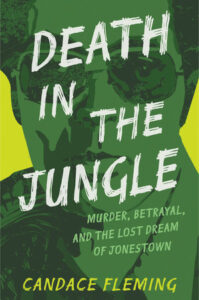
 Death in the Jungle: Murder, Betrayal, and the Lost Dream of Jonestown by Candace Fleming, published April 25, 2025, by Anne Schwartz Books.
Candace Fleming assumes a heavy, if noble, burden, in her latest book: explaining the Peoples Temple/Jonestown saga to teenage readers. “Explaining” is the wrong term, as if the existential questions posed by 918 purposeful deaths in a single day could be sensibly answered to a person of any age. But what Fleming attempts with Death in the Jungle: Murder, Betrayal, and the Lost Dream of Jonestown is to narrate the tragedy to an audience on their level, an audience removed from it by nearly a half-century.
One might question if Jonestown is a subject teens should be made familiar with. Their parents and grandparents may regard the incident as a grisly affair perpetrated by a bunch of kooks, best left forgotten as nothing more than a historical curio. What value is there in detailing such an “ugly” episode to America’s youth? It’s a reaction Fleming encountered while researching and writing the piece.
As a 40-year-old, I can’t attest to her work’s success with its target audience, but I laud her effort and the final product. From anecdotal experience, “Jonestown” is something young adults are largely unfamiliar. If they know the word at all, they’ve often confused it with what befell other failed new religious movements like the Branch Davidians or Heaven’s Gate. This is dismaying for several reasons, not the least of which is that the warning bells sounded by Jonestown are, arguably, ringing at their loudest since 1978. This alone should warrant Peoples Temple’s cautionary tale being, at least on a cursory level, a required element of any high school U.S. history course.
With that in mind, Fleming’s book is a commendable feat. It opens in media res to November 24, 1978, as American households watch a CBS special on the demise of the agricultural project in the Guyanese jungle. It then flashes back to Jim Jones’s childhood in Indiana, setting an ominous tone by relating some of his more unsettling boyhood tendencies.
This is not a Jones biography, though. Rather, it is an ensemble piece, with Fleming swapping Peoples Temple personages with each chapter. A handy cast list at the front is a welcome reference for keeping straight the names, especially those of the larger families.
Wisely, most of those she focuses on are themselves teens or young adults at the time of the action. Survivors Stephan Jones, Tommy (Thom) Bogue, and Mike Touchette receive the lion’s share of attention, their perspectives on their years-long development in Peoples Temple gleaned from interviews with Fleming and their own writings. Annie Moore, Jones’s nurse who joined the movement in her teens and died in Jonestown at age 24, is also among those presented as reader surrogates through her letters and Fleming’s interviews with her surviving sister, Dr. Rebecca Moore.
On the other end of the spectrum, Fleming explores Peoples Temple’s appeal to Black congregants through survivor Hyacinth Thrash and her sister, Zipporah Edwards. Both joined the organization in its nascent Indiana years while already in their fifties. Thrash’s account is largely pulled from her own book, The Onliest One Alive. Thrash’s perspective contrasts with those of the youths who were raised in Peoples Temple, showing how even intelligent elders who noticed Jones’s increasingly deranged behavior could remain with the organization by focusing on its positives.
The book is exceptionally well-researched, with every line of dialogue or quotation cited. As a nonfiction novel in the Capote tradition, it maintains a steady momentum of suspense and relief, of dread tempered with hope. Most chapters end in tantalizing cliffhangers, inviting readers to consume the book in large chunks. This means Fleming sacrifices some of the historical elements to maintain the story’s thrust. Gone are references to the Father Divine debacle, the Ijames family, adoptive son John Moss Brown Jones, Jones’s 1973 arrest for lewd activity in a Los Angeles restroom, and the defections of Debbie Layton Blakey, Grace and Tim Stoen, and Terri Buford. The Stoens’ custody battle with Jones over six-year-old John Victor Stoen, a lynchpin for what ultimately befell the settlement, is introduced and summarized fairly late in the game, but so much the better for narrative brevity. In this fashion, Fleming succinctly establishes historical contexts for an audience unfamiliar with the tech and geopolitics of the 1950s-1970s, as when, in a single paragraph, she explains why the Guyanese government would welcome an American camp near its border with Venezuela.
Fleming writes in rich detail and imagery, particularly as it comes to her descriptions of the titular jungle. While she does not flinch from the horrific elements, she also does not linger on lurid or more sensationalist matters. The author largely opts to omit graphic depictions of violence or sexual abuse in favor of allusion. Neither of two black-and-white photo galleries include shots of the gathered dead. For this reason and others mentioned above, Death in the Jungle may just be an ideal introductory book for the Jonestown story in general. If you’re an adult who is an infrequent book reader and aren’t snobbish about the “young adult” classification, you’d be hard-pressed to find a more accessible retelling of Peoples Temple’s beginning and end. Or maybe you have a teenage son or daughter, niece or nephew, who is asking questions on how huge swaths of Americans can become wrapped up in a movement that seems, to outsiders, hellbent on destruction…
In telling the story through the eyes of Peoples Temple’s youth, Fleming bridges the gap of nearly 50 years. Her protagonists’ youthful passion, idealism, and attitudes serve as touchstones for modern readers. The fact 113 of those died in Jonestown were teens itself welcomes contemporary youths to see themselves in the narrative. That, in turn, can only help teens to reflect and be alert to red flags of movements that have only increased in their frequency and predation in the decades Jonestown’s collapse. Fleming’s stated role is to help young adults “make sense of their present by revealing stories from our past.” Death in the Jungle doesn’t pretend to explain human failings to teens, but it does show those failings remain constant within us regardless of generation.
(Cole Waterman is a Michigan-based crime reporter with a long-held interest in Peoples Temple and Jonestown who has submitted numerous primary source transcripts from the FBI’s FOIA files to the site beginning in the fall of 2023. His complete collection of articles is here.)