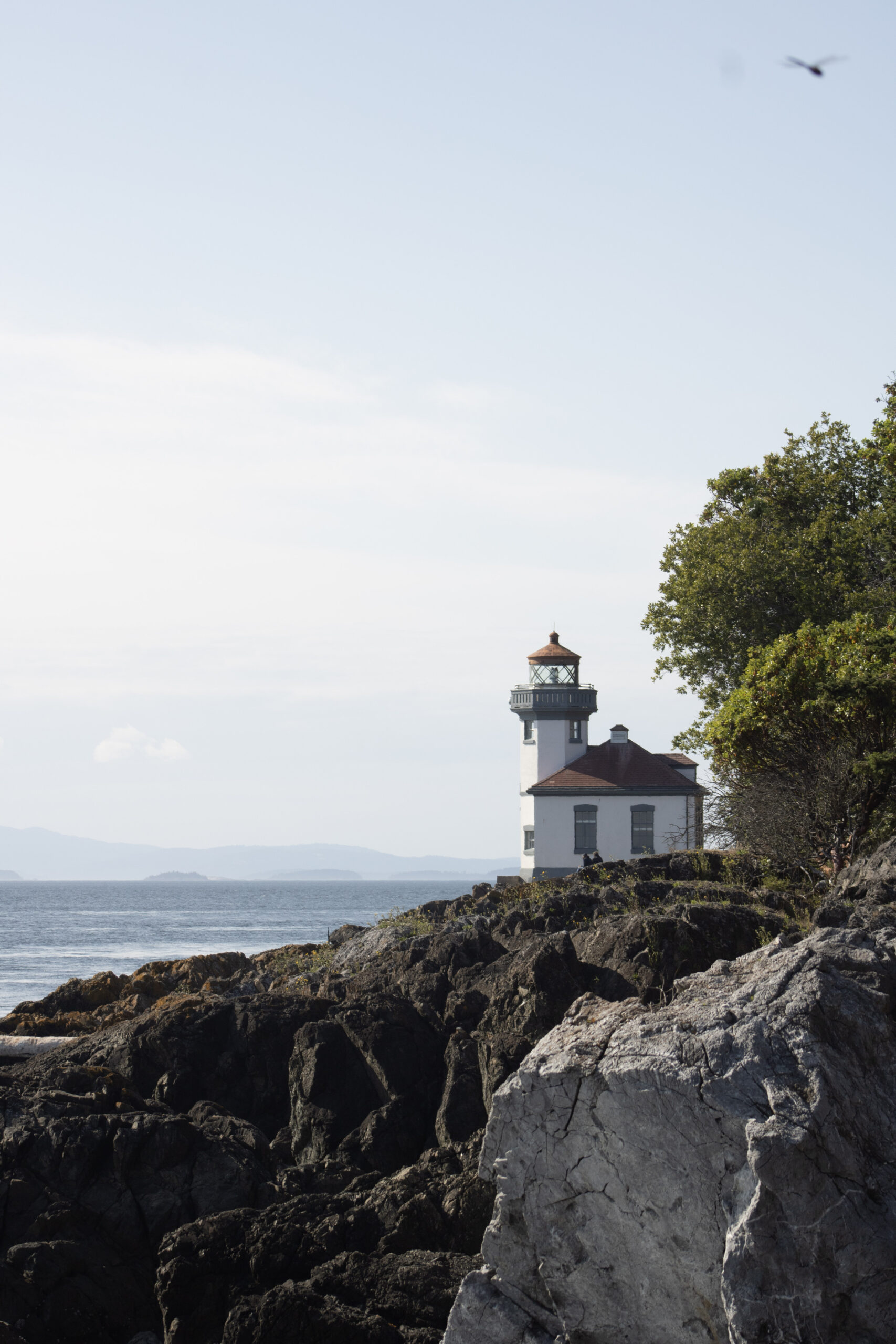
Earlier this year, the directors of this site, Rebecca Moore and Fielding “Mac” McGehee, invited me to visit their residence in Friday Harbor, Washington – the current physical location of the Jonestown Institute. I immediately took up their offer and was excited to finally meet the husband-and-wife duo in person, with whom I’ve exchanged hundreds of emails and hours of phone conversations.
Prior to the trip, Mac warned me about the filing cabinets stuffed with Peoples Temple records and correspondence that had not been touched, let alone scanned, in years. It was up to me to scan them.
Upon my arrival in Friday Harbor – an idyllic coastal town nudged within the San Juan Islands archipelago and accessible only by an hour-long ferry ride from mainland Washington – it was tempting to want to spend all my time on the island sightseeing, but, of course, I had files to scan.
Over the span of three and a half days, I scanned more than 6000 pages. In the upcoming months and years, many of these pages will be transcribed and made accessible on the website. The following sections describe the highlights of some of the collections I reviewed.
*****
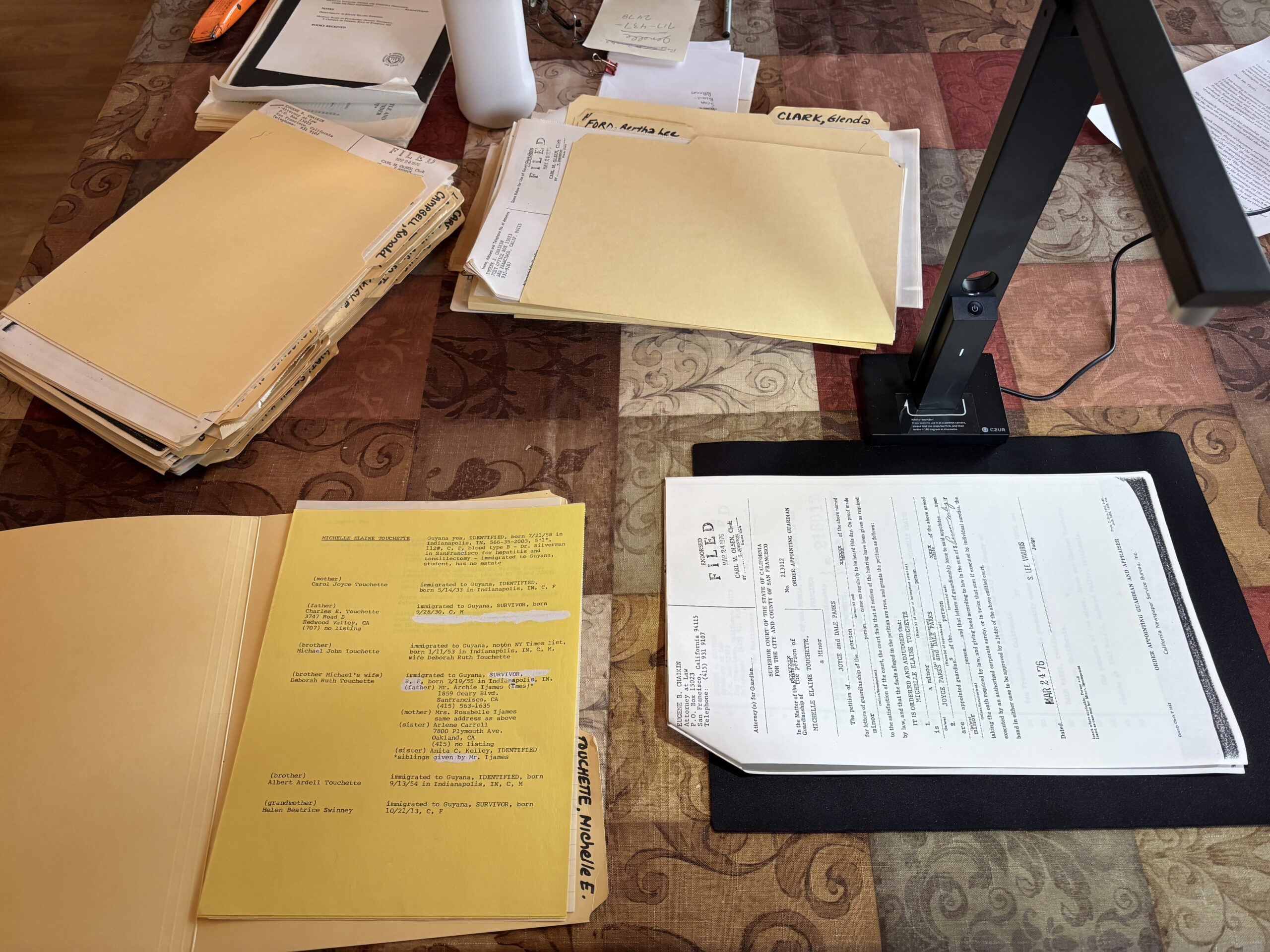 The first box I opened contained the personal files and records of the late psychologist Dr. Phillip G. Zimbardo. Dr. Zimbardo is perhaps most famously remembered for his 1971 Stanford Prison Experiment, but fewer know about his intense interest in “cultic” behavior, mind control, and unsurprisingly, Peoples Temple and Jonestown.
His files mostly consisted of his notes, research, and correspondence on a supposedly unreleased 1979 NBC documentary, Children of Jonestown. As the title suggests, the documentary focused on the 304 children who died in Jonestown and featured interviews with survivors, relatives, and friends of the children. During the documentary’s production, NBC researchers compiled extensive genealogical files on the family histories of many of the minors in Jonestown, including their custodial records. I have yet to deduce Dr. Zimbardo’s exact connection to the documentary’s production – let alone confirm whether this documentary was ever released in any form.
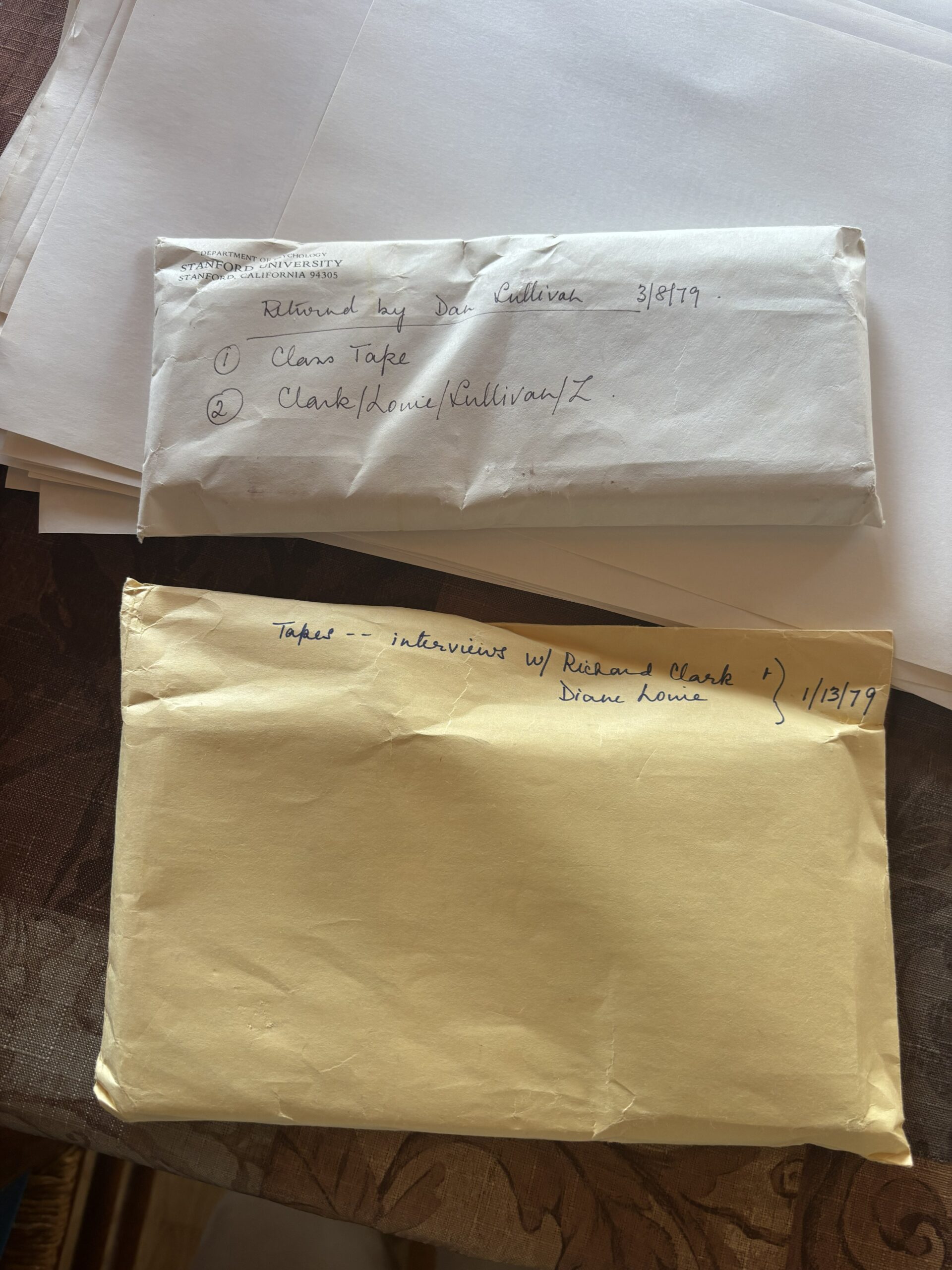
Also of significance are audio recordings of interviews with survivors Diane Louie and Richard Clark, who escaped with nine other Jonestown residents on the morning of November 18th under the guise of a picnic. Dr. Zimbardo maintained close correspondence with Louie and Clark in the years following the tragedy and even invited them as guest speakers to several of his lectures at Stanford University. As of October 2025, these tapes have been digitized and are currently being transcribed for this site.
Lastly, I scanned Dr. Zimbardo’s records on Larry Layton. Dr. Zimbardo served as an expert witness for the defense of Larry Layton during his 1981 trial in the United States. These records consist of Dr. Zimbardo’s psychiatric evaluations of Layton and trial transcripts.
*****
The next collection I scanned consisted of letters received by Claire Janaro from Jonestown residents, a Temple member and a survivor who is best remembered as the manager and “mom” of the Temple’s Ranch for developmentally delayed boys in Redwood Valley. Evidenced by the letters from dozens of Temple members and her two children, Mauri and Daren, Claire Janaro was fondly loved and embraced within the Temple.
There are letters from many Jonestown residents – from Tom Grubbs, Terry Carter Jones, and Edith Bogue, among others – which survived the censorship by the Jonestown “letter-writing committee” by extolling an idealized life in Guyana. Despite the sometimes-stilted language that contradict these same writers’ observations contained in intra-community reports and memos, the letters still provide valuable insights into how the community wanted to present itself. It is my hope that the letters will soon be transcribed and will accompany the other collections of writings and letters by Jonestown residents featured on this site.
*****
The largest collection I explored consisted of correspondence, notes, and the Freedom of Information (FOIA) files from none other than the website managers themselves. In the near half century since the Jonestown tragedy, McGehee and Moore filed more than fifty FOIA requests with more than 20 federal agencies, as well as three FOIA lawsuits against the Department of Justice (FBI) and CIA, in a search for all government records related to Peoples Temple, Jonestown, and some of its leaders. Their tireless efforts have resulted in the release of tens of thousands of documents on Peoples Temple, many of which are available and have been transcribed on this site.
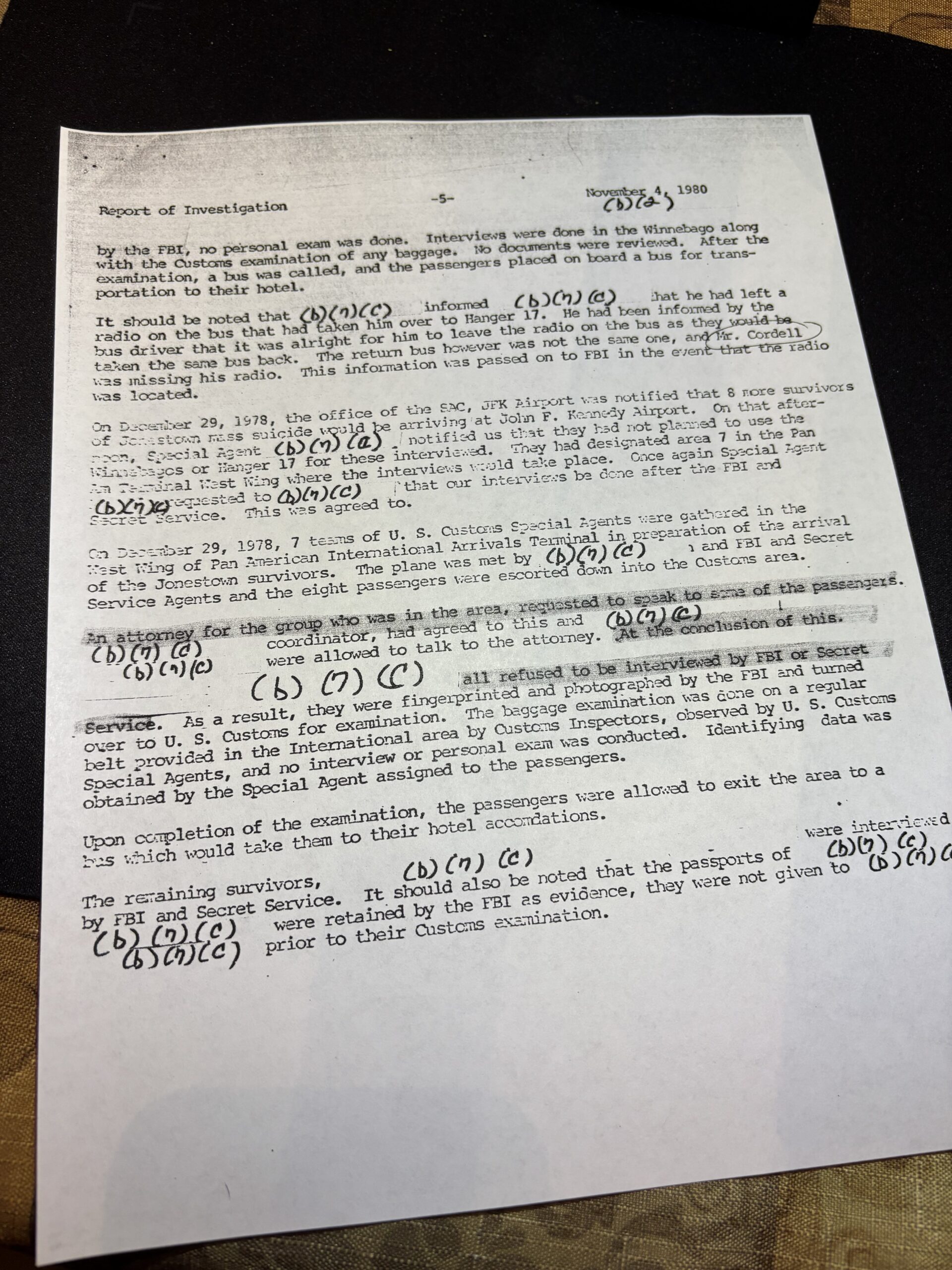
In contrast to the previous collections, McGehee and Moore’s files were less organized and visibly comprehensible, bearing evidence of their sometimes-scattershot efforts over the decades of research and work. They produced a significant paper trail going all the way back to the late 1970s, documenting correspondence with private investigators, attorneys, FOIA liaisons, and amongst themselves. As researchers such as myself have filed FOIA requests in search of additional records on Peoples Temple and Jonestown, this correspondence is crucial to learning the complex – and tenacious – process of FOIA requests and understanding records that federal agencies have yet to publicly release or unredact on Peoples Temple.
Of interest to researchers are additional FOIA records on Peoples Temple and Jonestown by other agencies such as the Customs Service, Bureau of Alcohol, Tobacco, Firearms and Explosives (ATF), Department of Defense, Air Force, and the CIA. While these records have not been uploaded to the site yet, they will be added soon, either to this website or the new digital project, Military Response to Jonestown, which Shannon Howard and I will manage. Much of McGehee and Moore’s notes and correspondence on their FOIA work has yet to be organized, let alone read; however, it will slowly become available to researchers as this website continues to expand.
*****
One collection I was particularly surprised to come across – and honored to scan – was the personal files of Grace Stoen.
Grace Stoen was one of the most prominent and vocal defectors from Peoples Temple, largely as the result of her custody battle against Jim Jones for her son, John Victor Stoen. Her collection consisted of records from before the deaths in Jonestown – her diaries and logs from 1978, her notebooks from her work as a notary for the Temple, family photographs – as well as post-November 18 correspondence with survivors and the media. Among the minutia are travel receipts from the Concerned Relatives and Congressman Leo Ryan’s fateful trip to Jonestown. Stoen also maintained an extensive collection of newspaper clippings on Jonestown both prior to, and in the aftermath, of November 1978.

Scanning Stoen’s records led me to remember how little time is left to best preserve the history of Peoples Temple and Jonestown. As the 50th anniversary of the Jonestown tragedy approaches and the number of living survivors inevitably dwindles, there are fewer and fewer opportunities for those still around to share their stories and collections. I have come to greatly appreciate the willingness of survivors like Grace Stoen to donate their files so that researchers in the future may have access to these primary sources.
*****
One of the final collections I scanned was the radio notes and transcripts of renowned mind control expert Dr. Margaret Singer. Prior to November 1978, Dr. Singer worked with the Human Freedom Center – led by ex-Temple members Deanna and Elmer Mertle (Al and Jeannie Mills) – to monitor Peoples Temple shortwave audio conversations between Jonestown, Georgetown, and San Francisco. While nearly all of the shortwave radio recordings have been digitized and are available on this site, some of the transcripts and radio code books are not.
Throughout the year, I have been working to organize and transcribe all of the radio code books and radio logs collected by the FBI in the aftermath of Jonestown. The addition of Dr. Singer’s notes and transcripts will prove useful in comprehending some of the coded radio messages passing between the Temple’s ham radios in Jonestown, Georgetown and San Francisco.
*****

There were many more documents and records of interest that I scanned during my trip that I have not described. Two days after I left Friday Harbor, Mac called me to report his discovery of another filing cabinet drawer to scan. My work is nowhere near finished, and I’m sure that I have thousands upon thousands more Peoples Temple documents to scan in the future.
As a historian-in-training and amateur archivist, I have come to deeply cherish the accessibility (especially the digital accessibility) of both primary and secondary source materials on Peoples Temple and Jonestown. I have conducted archival research on a myriad of other historical topics – many of which are objectively way broader than Peoples Temple – yet very few topics have such an extensive abundance of primary source materials available, let alone their own digital archive or institute.
But as a researcher, contributor, and arguably, a perfectionist, it is in my nature to want access to – and make accessible – as many primary source records as possible, whether that may be documents released under FOIA, interviews with survivors, audiovisual materials, or anything else remotely related to Peoples Temple. My search for any and all materials related to Peoples Temple has taken me cross-country and to the Pacific and Atlantic coasts. But as the 50th anniversary of the Jonestown tragedy approaches, we all have to acknowledge that we are in a losing race against time to collect, archive, organize, scan, and transcribe as many Peoples Temple materials as possible.
It is easy to put off archiving efforts as a chore for later, but dusty totes of letters inevitably go missing (and deteriorate!); the managers of this site and survivors grow older; and folks simply lack the energy or time to organize and donate their collections. Mac once explained to me that numerous survivors and researchers had once promised their letter collections, unfinished book manuscripts, and oral histories to the Jonestown Institute at some point in time. But more often than not, promises go unfilled. Thus, it is my hope – and request – that all living Peoples Temple survivors and researchers are willing to share their stories and donate their materials. This is not only an effort to preserve history for the present but also to preserve the history of Peoples Temple and its people for future generations.
The Jonestown Institute (and by extension, Special Collections at San Diego State University and the California Historical Society Collections at Stanford University) offers a viable repository for Peoples Temple-related collections.
The final letter attributed to Peoples Temple historian Richard Tropp read:
Collect all the tapes, all the writing, all the history. The story of this movement, this action, must be examined over and over.
Will we heed his final request?
(Aliah Mohmand is a student with an interest in Peoples Temple. Her research has resulted in multiple projects regarding the aftermath of the Jonestown tragedy. Aliah attends Kalamazoo College, pursuing studies in History and Finance. Her full collection of articles for this site may be found here. She may be reached at aliahmohmand@gmail.com.)