What a day in Savannah in November 2025 taught me about cults and the human desire for purpose and connection.

It took some doing to convince my husband – he was initially reluctant to go – but one morning in November 2025, we drove 12 hours from our home in Alabama to Savannah, Georgia to attend a true crime convention. See, this wasn’t just any true crime convention. It was the annual convention put on by the Graveface Museum, and this one was on “cults,” including Peoples Temple.
Even so, I might not have pushed my husband so hard to attend, were it not for the fact that former Peoples Temple member Eugene Smith was set to host a discussion and book signing of his memoir, Back to the World: A Life After Jonestown. I knew this was an occasion I could not miss. Most Jonestown survivors have understandably stepped away from the public spotlight, and I suspected this might be my only chance to meet him.
Members of other groups were slated to appear as well. Among them were Hope and Faith, two women who remain devoted to the memory of Amy Carlson, founder of the controversial religious movement Love Has Won. To her followers, she was Mother God; to loved ones from the past, she was simply Amy Carlson.
Love Has Won remained under the public’s radar until news of Carlson’s death, and the bizarre shrine-like setting in which her body was found, thrust the group into the national spotlight.
I remember the viral clip of Hope introducing “The Galactics,” a collage of mostly famous celebrities believed to be Mother God’s spirit guides. At first, I found the tableau comically absurd. Over time, however, I came to see Hope less as a Reddit punchline and more as a human being. I wondered if she was searching for something – a purpose, community. The same things that had me driving twelve hours to Savannah in search of people who shared my own interests. I could not relate to her beliefs, but I could, at the very least, understand the desire underneath them.
With this in mind, I resolved to listen to all the panelists’ perspectives with curiosity rather than judgment.
The first step, of course, was choosing my ticket. The museum offered three types of access to the convention, each at a decent price point. All ticket tiers granted admission to The Graveface Museum, a small but proud true crime and oddities museum located on the south side of the Savannah River.
The Graveface Museum
Rich in haunting history and 19th-century architecture, Factors Walk Road spans three levels that lead you to the city’s hidden treasures. The museum is one of them, located on a quiet cobblestone street framed with old brick warehouses that have been repurposed into shops, galleries, and restaurants. Tall live oaks draped in thick moss line the streets above the museum, giving it a cozy feel. It was easy to forget that the largest collection of John Wayne Gacy artifacts is housed within the building’s brick walls.
Designed with a devilish sense of humor, the exhibits lie behind a bright red papier‑mâché structure shaped like Satan’s head. Once inside, guests are met with an array of oddities: shrunken heads, Fiji mermaids, a five-legged cow, and a mummified hand said to belong to a chupacabra. It is a dizzying spectacle that pays homage to mid-century roadside attractions, popularized by charismatic showmen.
But deep in its cabinet of curiosities lies a deeper mission – one that Chloe Manon, the co-owner of the museum, summed up with sincerity: “The reason we really opened it in the first place was to give a home to all the items that we have gained over the years from people that had a personal experience, or connection, to these dark parts of history.”

Fifteen years ago, Chloe’s husband, Ryan Graveface, opened a record store that housed a peculiar mixture of vinyl records, macabre artifacts, and taxidermy animals. Some of the historic pieces in the pair’s collection are now housed in their museum. Among them is a small but sobering exhibit on Jonestown, which includes a set of Flavor Aid packets reportedly taken from the site itself. A pair of dark sunglasses, said to have belonged to Jim Jones, rests on an unsettling mannequin head crafted to look just like him.

“One day, a regular came into the shop and got to talking with Ryan about Jim Jones and Jonestown,” Chloe told me. “Ryan had some enamel pin or button regarding Jonestown, and the guy mentioned that his aunt had been in Peoples Temple. Fortunately, she left before they went to Jonestown. She was a member in Indiana and moved to California.
“A few weeks later, the regular comes back with a bag of journals and these sunglasses in a baggie that said Father Jones 1960,” Chloe continued. “That is where Ryan got the story that Jim Jones carried extra pairs of his glasses around to woo people and impress them, because they were such an iconic part of his look. The aunt told her nephew he would actually give people these as gifts, and she received a pair.”
I can’t say with complete certainty that the sunglasses did indeed belong to Jim Jones. According to Chloe, their owner was among those who reportedly grew disenchanted with Jones and left the church, her name now largely lost to time. After her death, her journals and personal belongings passed to her nephew. One of those items eventually found its way to the record store, where it caught the eye of a man who claimed to have his own connection to the massacre.
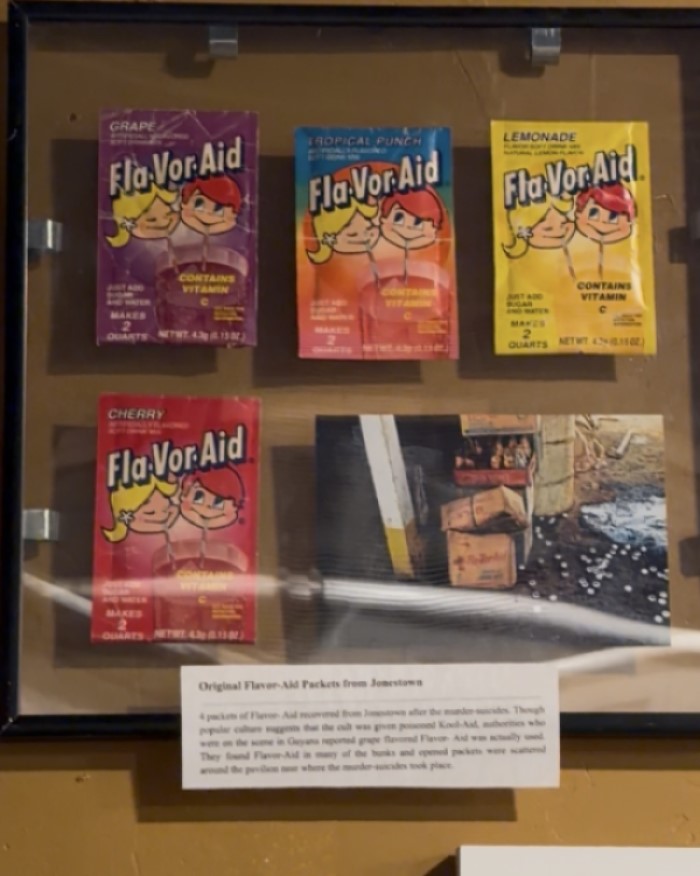
One day, a military veteran stopped by their shop where Jim Jones’ sunglasses sparked his curiosity.
“He was there during the cleanup,” Chloe recalled. “He actually is the one we got the Flavor Aid packets from. He just kept them. He even admitted, ‘I don’t even know why I grabbed them.’ It just lived in a box in his closet for decades.”
“[These are] personal stories,” she reflected further. “People holding onto these things and realizing, why am I holding onto them? And then passing them along. We are a repository for that stuff.”
The couple’s desire to share different perspectives on some of history’s most infamous events is the reason why they decided to stage a true crime convention. “I just want to know more and going straight to the source is usually, in my opinion, the best way of doing that as opposed to theorizing or speculating. Just asking questions to people is very valuable.”
It was a noble concept that could make all the shrunken heads in the museum nod in agreement. True crime has long occupied the public’s imagination, fueled by late‑night TV programs that sensationalized the grisly details of murder and mayhem. The Graveface Museum leans into some sensationalism, but their desire to preserve dark parts of history and illuminate its human cost is unmistakable.
It comes as no surprise, then, that the Graveface Museum is now one of Savannah’s top attractions. In recent years, social media has introduced audiences to a new generation of controversial movements. Streamers followed suit, and that was how Love Has Won was introduced to the world.
Dubbed the Cult of Mother God, the eclectic cast of spiritual seekers featured in the HBO documentary took the viewers on a surreal road trip – one that was equal parts bizarre, oddly tender, and ultimately tragic, ending with the death of Mother God herself.
Finding Mother God
Faith had no idea Mother God existed. She had journeyed through fifty-three countries, driven by a restless pursuit of the age-old question: why am I really here?
It is a question that inevitably confronts us all.
“They tell you, ‘what are you going to be when you grow up?’” Faith recalled her childhood days in Northern England. She recited the professions society deemed exceptional: mechanic, lawyer, doctor. She chose to pursue law school because it suited her competitive nature. Still, she could not shake the feeling that there was more to life beyond the confines of her hometown.
“I always knew in the background that is not why I’m really here,” Faith admitted. “This is not what life is about. This is something that humans have decided to create. And so for me, in the background, there is always this yearning to find the truth.”
She had been chasing answers since she was sixteen, when she first broke away from home with her younger brother in tow. They spent eight weeks in Australia before returning to the daily rigors of English life. A few weeks after her seventeenth birthday, she bid her mother goodbye and bought a ticket to Thailand. Alone, she wandered the country searching for the truth.
“The experience of growing up in England – and I feel the same in a lot of places – was just…” Faith trailed off, shaking her head. “This routine existence and the bills – there is more. There is more that we’re here for.”
She reminisced about the days when she moved from one country to another, meeting locals and staying in their homes.
“Even when I went through challenging things like being mugged or things that happen on the road, nothing was ever going to stop me from traveling. Until I met her.”
A Click Away
Faith spent fifteen years crossing continents in search of the truth. Hope, on the other hand, found hers with a single click.
Hope recalled the moment when she first learned of Amy Carlson. “When I found the website and it said Mother God – I was like, this makes sense. There is a Father God. Why would there not be a mother essence? It kind of puts men and women in two different departments, where men can be God. But what about women? The creators of life that birthed the children?”
“I was more nervous meeting her,” she continued. “This woman calls herself Mother God. I was intimidated at first because you could feel how powerful she is. Someone’s aura does not lie. When you are around certain people, you can tell when someone’s really nice or when someone’s really mean or angry. People wear their emotions; you can feel it in their energy.”
Many critics of the group would reject that assessment. The Mystery and Murder: Analysis by Dr. Phil podcast, for example, describes Amy Carlson as “the leader of a notorious cult built on sleep deprivation, forced labor, and financial exploitation.” Former members and outside observers have also accused the group of neglect and abuse.
Hope’s story, and her fond recollections of a woman who would become a defining figure in her life, are easy to dismiss if viewed solely through the lens of Love Has Won’s online notoriety.
As she reminisced about her early encounters with Amy, I found myself less interested in the movement’s extraordinary claims than in the human yearnings beneath them: the search for purpose, friendship, and a sense of finally coming home.
While I was at times frustrated by their refusal to entertain doubts about Amy Carlson and her teachings, or even to acknowledge her human flaws and the movement’s shortcomings, their devotion appeared to be rooted in genuine care for her and in needs that I could understand. And, in a way, I get it. I, too, am devoted to my religious faith. As former Peoples Temple member Deborah Layton once said, “Nobody joins a cult. You join a self-help group, a religious movement, a political organization.”
After all, the desire to find a higher purpose in life and a place to belong is a deeply human one. People want to feel loved and valued. They want to feel seen. Whatever I thought of their beliefs, those longings felt achingly familiar.
“I will never forget days where she was just not feeling good,” Hope recalled of Amy’s failing health. “Some days she would be throwing up. I will never forget, one day she was really sick and asked how I was. And I was like, why are you asking how I am? You are the one that is really sick. And around my birthday, she was really sick too, but she still remembered my birthday and got me some gifts.”
Hope explained to me why she believed. “There was never really any doubt about who she was. I think it was an immediate trust. I heard her stories and I remember even early on, I was struck by the way she carried herself with forgiveness. Going through some really traumatic experiences, she chose forgiveness. I remember thinking, I could never do that. You have all my respect. I know you’re special.”
It is no surprise, then, that Hope remains protective of Amy’s memory. For Hope, Amy may have possessed some supernatural abilities, but her divinity was grounded in her human struggles. There is much one can say about Amy Carlson: her eccentricities, her beliefs, and the cult of personality she built around herself. But whatever conclusions are drawn about her short life, there is little doubt that she suffered greatly in her final days, leaving behind friends, family, and devoted followers.
Hope recalled some of the turmoil that surrounded Amy during her illness, and the way she believed Amy responded to it with forgiveness and compassion. One incident, she said, involved a member of the group whose behavior could be unpredictable.
“I always tell people there were a couple of times where he was just being rude and he spilled a drink on her intentionally,” Hope recounted. “I took a drink and I threw it on him right back. And I’m like, this is how you’re going to be to a woman? I’m not going to tolerate it. She just showed overwhelming forgiveness for him.”
“Something like that? Water off a duck’s back!” Hope continued. “That didn’t even faze her. She would think it’s funny, or if I threw the drink back, she would think that’s hilarious and that he’s a goof! We couldn’t handle craziness, and she did it in such a way that I just don’t think I could handle it, or other people, so I always give her credit.”
To Hope, these moments spoke to what she believes was Amy’s true nature: selfless, loving, compassionate. The circumstances surrounding her death, however, painted a far more complicated picture.
In December 2021, CBS News reported that it had obtained the Saguache County coroner’s report which revealed that Amy Carlson had died as a result of alcohol abuse, anorexia, and chronic colloidal silver ingestion. Her death accelerated the collapse of the movement, leaving her followers to grapple with the uncertainty of their future.
For Hope and Faith, the aftermath of Amy’s death and the fracturing of their community brought a more immediate concern to the forefront: stability. With Mother God gone, Faith knew she needed to find some kind of equilibrium for herself and her son.
“The main thing was we knew we had to get some stability to be able to kind of decompress,” Faith recalls. “I have a son, so I went with him, and I knew that I had to really, really ground in and be present with him through those experiences.”
Both women describe the days and weeks following Amy’s passing as a blur of grief, upheaval, and intense public scrutiny. Amid heightened media attention and ongoing police investigations, members of the group found themselves scrambling to establish new online platforms while searching for a place to live. They fielded inquiries from reporters as well as documentary filmmakers. Mounting questions from online spectators added to the growing pressure to provide answers.
It was in this environment that Hope and Faith agreed to be filmed for a documentary. “By the time the director came to me to do my interview, it was six weeks after,” Faith says. “I remember just not being okay. I was visibly not okay. It was too soon.”
She began to have doubts about participating in the documentary. “I think our grieving process was very stop-start because of that; it has definitely been a very long process,” she reflects further.
“For probably the first year, we were still in fight-or-flight [mode],” Hope concurred. “Everything collapsed in the opposite direction… I would never wish for someone to lose a loved one and then have a camera in their face not even a month later. Looking back, I wish someone level-headed had told us to take a break, regroup, and heal. But we just went full-throttle.”
“Everything was so rushed and crazy,” Hope continued. “Probably a year after that is when we finally began to calm down and digest everything and really start to grieve her. I think we kind of pushed that out for HBO. We wanted to get our story out and this would be great and all these things, which it wasn’t. Looking back, I wish we took time for ourselves. We were overstimulated.”
The constant upheaval, the loss and grief, and the rolling of cameras seemed to have pushed Hope to her limits. “Oh, I can push, I can do it!” she recalled. “Looking back, I should just have taken time for myself.”
Cult Con
We had planned for just a single day in Savannah. My husband and daughter were going to explore the shops, restaurants, and tourist traps that lined the city’s cobbled streets, while I squeezed every possible benefit from my VIP ticket at CultCon. Not quite knowing what to expect, we packed a small suitcase and set off on the twelve-hour drive to Georgia.

The convention itself was smaller in scale than I expected. Rather than focusing on serial killers or unsolved crimes, the organizers devoted the day to famous cults. At first glance, few distinctions were made between them. The event poster placed Amy Carlson alongside Jim Jones, Charles Manson, and Marshall Applewhite. This raised an obvious question: did these leaders and their movements belong in the same category?
Chloe Manon welcomed the comparison as an opportunity for discussion.
“We had a few different perspectives [from the John Wayne Gacy case] and it was just really interesting to gather all of that and have them all in one room for the day,” she explained. “A lot of interesting dialogue arose from that, so this year we wanted to focus on cults in the same way; not specifically dissecting one from different perspectives, but having a look at well-known or notorious cults from different perspectives.”
Hope appeared resigned to the fact that Mother God would now share the infamy of Jim Jones and Charles Manson.
“We have been used to this for a while, with these other cult leaders,” she said. “I think it is kind of funny where she is next to all these men. For us, it is just best to see the humor in things. She would see the humor in things.”
The meet‑and‑greet began an hour before the doors opened to the public. The event occupied a cozy space overlooking the Savannah River. Around five or six vendors lined the area, selling everything from rosary beads to hot sauce. I picked up a copy of Eugene’s book, hoping for a chance to have it signed.
Scanning the room, I caught sight of Eugene in quiet conversation with an attendee. Dressed in a black blazer and blue jeans, he stood apart from the crowd, his casual attire conveying a restrained elegance. A few minutes later, he made his way to the table he shared with Tom O’Neill, author of the acclaimed CHAOS: Charles Manson, the CIA, and the Secret History of the Sixties.
The meet-and-greet had begun, though only a few seemed to notice. A young man stood nearby, staring fixedly at Eugene’s table. I hurried over, struck up small talk, and encouraged him to break the ice by starting the line. Finally, he made a beeline for Eugene, leaving me a chance to speak with Tom O’Neill.
Meeting a well-known author had me flustered. I stammered a few compliments about the audio version of his book, shook his hand, and moved along. Before I knew it, I was standing in front of Eugene, a million thoughts racing through my head. I wanted to thank him for writing a book that has given researchers like myself a clearer understanding of the Jonestown tragedy. I wanted to offer condolences for the loss of his wife and son. I had so much I wanted to say. In a rush of words, I confessed my shock at the scrutiny and harassment Jonestown survivors endured.
He was extremely gracious. He stressed that the tragedy did not end on November 18, 1978. In a way, for many survivors like him, it had just begun.
“1979 to 1989,” Eugene recalled, describing a decade spent under the glare of relentless suspicion.
Near the end of our brief conversation, he reminded me that many who lived and died in Jonestown did not do so willingly. He pointed to evidence that some victims received cyanide injections rather than drinking the poison themselves.
I felt a knot of emotions as I walked away from Eugene’s table. For the past year, I had lived inside Jonestown’s history, writing articles and transcribing hundreds of letters from its victims. It was almost like I knew them. The excitement of attending my first true crime convention faded the moment I saw Eugene. Jonestown was no longer just a small exhibit at The Graveface Museum or the subject of a research project; it was painfully real.
I was still carrying these emotions when I approached the table of Heaven’s Gate. Sawyer, a former member of the group, was participating in the event. He was generous with his time, defending the memory of the people he once called his family. Though his convictions are far from mine, I listened with genuine curiosity in an earnest attempt to understand what sustains his continued devotion.
As I approached the table of Love Has Won, I felt a shift in energy. The small space the group occupied buzzed with activity as visitors lined up and interacted with women dressed in boho chic attire. I found myself chatting with Hope, a tall, bubbly brunette who had a way of making strangers feel like old friends. Before I knew it, I was receiving a card reading from Faith, a petite blonde who seemed perfectly at home amid the crystals and colorful gemstone necklaces. The scene felt strangely familiar, like a sleepover I had somehow missed growing up.

Faith shuffled a deck of brightly colored cards and laid one on the table. I turned it over, expecting to see an image of Mother God riding on a spaceship. Instead, it offered a message of compassion. Faith reminded me to give myself some grace; at that point in my life, those were the words I needed to hear. It truly resonated with me. Then she rifled through the deck and pulled a few more, allowing me to examine their messages.
“Drink Coffee,” one card implored. “Have Faith – Mom’s Got Our Heart,” read another, featuring a photograph of Amy Carlson, her cheeks full and healthy, her thick blonde hair draped over her shoulders. She smiled out at me from another time. She looked healthy back then.
As I moved away from the table, I felt a pang of sadness and the sudden realization that perhaps, long before a charismatic leader entered their lives, many of those drawn into such movements had been searching for the same things I was: friendship, purpose, the truth of life, and a place to belong.
I was suddenly confronted with an uncomfortable thought: Would I have joined?
Hope and Faith remain steadfast in their beliefs and continue to speak of Amy with what appears to be heartfelt love and affection. Yet even they seem to understand how movements, regardless of how sincere their initial intentions may be, can fall prey to abuse and corruption.
“You have got to know what is love and what is transparency,” Faith told me. “What feels great when you are discussing versus what is infusing fear. Because if it is infusing fear and paranoia, it is going the wrong direction. I know Eugene spoke about that a lot, about the paranoia that was building up. That means you are in an environment that doesn’t feel harmonious and that does not feel safe. So you have got to trust that inner feeling and know if something is fear or love.”
I asked whether they ever felt that way about Amy. Both women shake their heads.
“Never,” Faith said without hesitation. “She exuded love.”
Maybe that is one of the questions at the core of every story like Peoples Temple, Love Has Won, or any other movement that offered a sense of meaning and community. The question is not simply whether people were deceived, but whether the purpose and connection they found felt real to them while it lasted.
I never did get to enjoy the full perks of my Priority VIP ticket. After listening to personal stories of intense loss and grief, I was left with an overwhelming mixture of emotions. I just wanted to leave. And so not long after my card reading with Faith, I called my husband and asked him to pick me up. He and my daughter were already on their way to the ferry, eager to take in the sights of Savannah. We only had one day in the city, and with a newfound appreciation for what I already had, I chose to spend the rest of it with those who mattered most.
Note: The quotations in this article are drawn from interviews conducted with Hope, Faith, and Chloe in the weeks following the conference unless otherwise noted.
Sources:
Interview with Hope and Faith (personal interview)
Interview with Chloe Manon (personal interview)
Video clip, The Galactics, https://www.tiktok.com/@binge/video/7322649668880551170?is_from_webapp=1&sender_device=pc
HBO, The Cult of Mother God: Love Has Won: The Cult of Mother God | HBO Max
Dr. Phil. Playing God: Amy Carlson and the Love Has Won Cult. Mystery and Murder: Analysis by Dr. Phil. Available at:Playing God: Amy Carlson and the Love Has Won Cult | Mystery And Murder: Analysis By Dr. Phil
Graveface Museum, John Wayne Gacy: John Wayne Gacy – GRAVEFACE MUSEUM
GrimmLifeCollective, Graveface Records & Curiosities in Savannah, GA
YouGov, True Crime: True crime: How does the genre affect Americans?
WTOC, True Crime Con 2025: Cult survivors share stories in Savannah
Time, The Bizarre True Story Behind HBO’s Love Has Won Docuseries
[Danielle Redifer became interested in the early years of Jonestown and the people who built it. She maintains an account on the Jonestown Pioneers on Instagram that documents the work of the pioneers, and honors the victims of the tragedy. She has also contributed transcripts of numerous primary sources to this site. The collection of her writings for this site may be found here. She may be reached at filipinawifelife@gmail.com.]