I discovered only ten podcasts this year – including a couple that predate 2026 that I hadn’t known about – and I suspect the three of the remaining seven, those of Crime House, used the same script.
I did notice a new significant pattern this year. With one exception, podcasts aren’t playing any segments from the “Death Tape”. Its existence is mentioned, but never used. In past years, nearly every podcast clipped at least some of it. Maybe trigger warnings have finally sunk in enough to where it’s just not broadcast.
 Stuff You Should Know: January 18, 2024
No sources are given, though I suspect all the research was done on Reddit. No custody battle between Jones and the Stoens, and Jackie Speier did not lay on the airstrip tarmac alone for 22 hours “playing dead”. This year’s winner of the “Time I can’t get back” award.
 Twisted Tales with Heidi Wong: December 1, 2025
This is the first of several offerings from Crime House. The format here is to reveal the true stories that inspired a film. In this case, the film is Ti West’s The Sacrament, which was reviewed in the 2014 edition of the jonestown report. The discussion of Peoples Temple only lasts for about 17 minutes, so there’s not a lot of depth here.
 Crime House 24/7: August 15, 2026
Another offering from Crime House, this is part of the Saturday “Cults & Cons” offerings hosted by Vanessa Richardson, whom we’ll hear from again. The impetus for this was newly-transcribed State Department cables. There are a couple mistakes worth noting:
- Jim Jones’ communist leanings did not isolate him from his mother.
- Jim did not give Marceline Jones any jewelry or expensive clothing to keep her happy, and she only stayed because these material things benefitted her.
No sources are listed, so I’m not sure where these mistakes come from. The podcast relies on Debbie Layton’s book Seductive Poison, so maybe that’s a source? It’s an okay episode. but Crime House did much better this year.
Crimes of Reddit: June 30 and July 7, 2026
Oddly not researched on Reddit, this is another Crime House production that use Jeff Guinn’s book The Road to Jonestown and Marshall Kilduff’s book The Suicide Cult as sources. The format here is that one of the two hosts goes into the discussion completely blind on the subject, but because Peoples Temple is so well known, it doesn’t quite work here. The podcast tells the basic story, with a special emphasis on civil rights, Father Divine, the Rainbow family, and Leo Ryan.
This is pretty good for a two-episode show, and watching it on YouTube, where there are visuals, is a nice change. There are a couple of errors, the funniest one being that there were cars in Jonestown instead of just a big truck. When I heard that, I pictured one of those big late 70s Lincoln Continentals stuck in the mud outside Jim’s cabin, although Jim would probably think that model car was too bourgeois.
(It should be noted that the 1980 made-for-TV film Guyana Tragedy, starring Powers Boothe, depicts Tim and Grace Stoen driving up in a car to the Port Kaituma airstrip shortly after the congressman and a score of others are assassinated. The Stoens are similarly gunned down. There are more than a dozen factual errors in that depiction of events.)
Serial Killers and Murderous Minds: December 22 and December 25, 2025.
Another Crime House production that asks the question, “what makes people kill?”. This time, host Vanessa Richardson teams with Dr. Tristan Engels, a licensed clinical and forensic psychologist with a focus on recidivism and behavioral patterns, to answer this question with regards to Jim Jones.
Dr. Engels does preface her remarks by saying she never interviewed or treated Jones and that this is not a formal diagnosis. She then offers many insights into Jim’s behavior. For us, some of these insights are well known because we’ve been reading and studying Peoples Temple for decades. So, when she says that Jim’s involvement with church as a child was a way to fill the attention deficit from his parents, we all know that. We know that Jim became a minister because a minister has built in followers. and that appealed to Jim’s narcissism. But remember, the people listening to these podcasts may not be as well-versed as we are.
Having said all that, there are some other insights that were a surprise. When Jim threatened, in front of Peoples Temple members to kill Marceline when she tried to leave him – the source of this assertion is unknown, but not completely out of Jones’ character – that filled both “personal and performative” roles. The personal is obvious, the performative is the message that he sends to the other members: “If he’s willing to kill his own wife, what will he do to me if I try to leave?” Dr. Engels also tried to answer the question of why people stayed, and to her, it came down to this: They had been conditioned to believe that Jim Jones was the only measure of their worth. That combined with the sunk-cost fallacy made most people unwilling to leave. I would argue that family ties and one’s own safety were also contributing factors.
There is one tremendous mistake that I must point out because I could not figure out where it came from and I actually rewound the podcast to make sure I heard it right. After wounding two people on a plane at the Port Kaituma airstrip, Larry Layton disembarks, hops into the tractor with the rest of the Red Brigade to return to Jonestown, and still manages to survive the final White Night. I think this is based on the photos of Larry in Jonestown after November 18 helping identify bodies. But don’t let this mistake dissuade you from checking this one out. It is the best thing Crime House did on the subject.
 True Crime Kent: August 4, August 11, August 17, 2026
Finally a podcast that wasn’t made by Crime House. First warning, Kent’s vocal tone and the rhythm of his speech takes some getting used to. Every time I turned it on, I spent ten minutes resisting the urge to turn it off. Second warning, this is a humor podcast and some of the jokes land, like when Kent calls Wings of Deliverance “the house that spider monkeys built.” And some don’t land, and sometimes, for instance, when they call socialism, “communism light,” I can’t tell if it’s a joke or not.
The sources mentioned are Guinn’s book and Raven, Tim Reitermann’s book. There’s a couple of odd things that are said and few outright mistakes so I’m not sure if there is another source or they just misread their script. They point to Jim’s obsession with his hair when he was a teenager as a sign of his growing narcissism. That insight would mean that literally everyone I knew in high school was a narcissist. They also state that Peoples Temple built the airstrip at Port Kaituma, which even Wikipedia would tell you is wrong. Jim wore sunglasses to hide the effects of drugs, not light sensitivity. Debbie Layton had been living in Jonestown when she defected. These mistakes are minor, even typing them seems like I’m quibbling. They aren’t deal breakers.
There are also two things that I’ve rarely heard discussed. First, this podcast is only the second I’ve heard to ask whether Jim was sexually abused as a small child running around Lynn with no adult supervision. They believe he was, based on how, even as a small child, he knew quite a bit, in graphic terms, about sex and shared it with the other children.
And second, in episode three, my favorite discussion of the year occurred. They spend a great deal of time discussing the various critters surrounding Jonestown that discouraged escape. Insects, reptiles, snakes, (I know snakes are reptiles, please don’t email me), and large cats. Even the critters that don’t kill you can still make you pretty miserable (bullet ants). I’ve never heard or read of such a comprehensive description like this. Their purpose in doing so was to answer all the, “Well why didn’t people just run away?” questioners.
If the voice and humor aren’t off-putting, check it out, especially episode 3.
 Opperman Report: July 2, 2026
Former private investigator Ed Opperman who, to his credit, was looking into Jeffrey Epstein as far back is 2013, hosts this show. I’m not sure if he believes what his guest Joseph Green says about Jonestown, or if he is just giving Green a platform. Whatever the case, Green has picked up where John Judge left off, and the topics are Dan Mitrione, the CIA, and what happened at Jonestown.
A number of assertions are made, including that Jim was right-wing in the 1950s because he met with John Birchers. If we follow this logic, I can only surmise that Green believes Malcolm X was a Klansmen because Malcolm met with Klan members in 1961. What’s missing is context.
More assertions include: Jim’s connections to the CIA, that the guy who purchased the land for Jonestown was a CIA agent, with the implication then that CIA money made the purchase. That someone tried to stab Leo Ryan in Georgetown before the trip to Jonestown, and that Leo Ryan was killed coming off the plane at Port Kaituma before going to Jonestown, and that “mistake” is why Jonestown was eliminated. No further information is given for these claims, nor does Opperman challenge the claims. They’re just fed to the audience as if they are true and have been thoroughly checked out. A historian or reporter – even for a high school newspaper – would have asked for proof of these claims, yet the host does not.
Then things get weird.
There were no suicides in Jonestown. Dr. Mootoo testified to it at trial. What trial? Does Green mean his testimony on December 13, 1978 during the Guyana Inquest? Because an inquest is not a trial, it does not determine guilt or innocence.
Rebuttal: Speaking of that testimony, Dr. Mootoo stated that he found “acute cyanide poisoning” in 25 unidentified bodies and in an unknown number of bodies identified by Odell Rhodes. A US embassy cable from December 15, 1978 (Serial 1232) says 64 bodies. The US Embassy cable and the inquest remarks can all be found online.
Newcomers to Jonestown were tied up and beaten. While residents of Jonestown were physically abused, there is no evidence of a systematic “welcome to the Promised Land” beating. One of the surviving audiotapes has one of Jones’ sons torturing someone. Which son? Which tape? What’s the date?
Again, none of this is challenged in any way. There are no follow up questions, no clarifications, no names, no dates, nothing.
The only thing I heard that I agreed with was their description of Jonestown as a slave labor camp, although Green’s assertion of its sponsorship by the CIA is a leap I’m not prepared to make. Yes, the CIA has done terrible things in its history, that doesn’t mean it’s responsible for every terrible thing that happens.
A defender of this podcast might point out that none of the podcasts that tell the “official story” get challenged either. That’s true, but most of them state their sources, and those sources state their sources, which are often primary sources.
At the end, Opperman calls Green a great storyteller. Indeed, he is.
Inkspot Podcast: November 18, 2025. (date not a coincidence)
Author Annie Dawid discusses her novel Paradise Undone, a story of life in Jonestown that attempts to humanize the people who perished at Jonestown. Dawid discusses the conditions in Jonestown and lightly touches on the custody battle that she believes was the beginning of the end. The book makes an interesting use of a native Guyanese character to discuss the effect that November 18 has had on Guyana itself, stating in the interview that Jones has colonized the memory of Guyana, and that until recently, every time a news item on Guyana made the newspapers, Jonestown was mentioned.
If the purpose of the podcast was to promote the book, then it worked because I bought a copy.
 The Casual Criminalist: December 5, 2023
The host, Simon Whistler, reads a “60-page script” that runs past the three-hour mark. The main source is clearly The Road to Jonestown, by Jeff Guinn, since the first 20 minutes are all things about Jim Jones’ mother Lynetta that we all read in Guinn’s book.
Whistler has a British accent and he talks really fast. Sometimes, I rewound to listen again because I missed something. It’s also a humor podcast and some of it lands and some of it doesn’t.
The only thing I heard that caught my ear is Whistler’s belief that the dark turn in Jim didn’t start with drugs, it started with meeting Father Divine. Interesting.
If you know the history of Peoples Temple through Guinn’s book, you can skip this one.
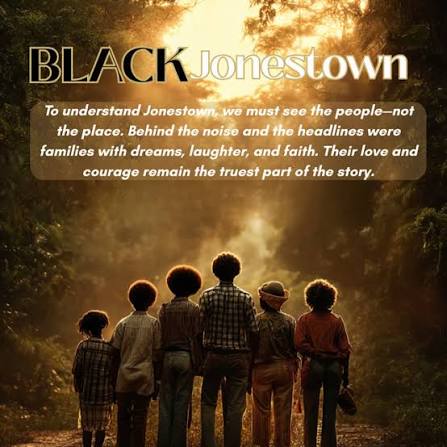 Black Jonestown: Started in December 2025
(It has its own theme song, how cool. And there is a YouTube version if you prefer to watch.)
Jonestown survivor Leslie Wagner-Wilson has decided to collect and share the stories of African American members of Peoples Temple. Some of this is done by interviews with former members, interviews with authors who write on this particular subject, and with tributes to people who died in Jonestown.
This podcast is ongoing, so I can’t really give it a “final grade” as I usually do. I can tell you it’s an important podcast, that it is necessary to give voice to stories that are on the verge of being lost forever.
I can tell you there have been some “oh shit, did they say that?” moments. Nancy Shaw, the guest in the second episode, stated that there are people still living who need to be held accountable for either the murders or the conning people out of their property and money. She then pivoted to asking how much Jim’s surviving children knew about the con job. So yeah, there are some of those moments where people’s raw emotions about the whole thing come to the surface.
These episodes are definitely worth listening to.
(Jason Dikes holds a degree in broadcast communications from Stephen F. Austin State University, an MA in history from the aforementioned institution, and an MLS from The University of North Texas. He currently is an adjunct professor American history at Austin Community College and a cataloging librarian for the City of Round Rock. His complete collection of articles for this site may be found here. He may be reached at jdikes@austincc.edu.)