[Leigh Fondakowski is the playwright and director of the play, “The People’s Temple,” and author of Stories from Jonestown. Her collection of articles for this site is here.]
It was one of those interviews that you never forget. More than twenty years later, I can readily recall her words, the picture window in her cramped Oakland apartment, and our conversation. Juanita Bogue, who died earlier this year.
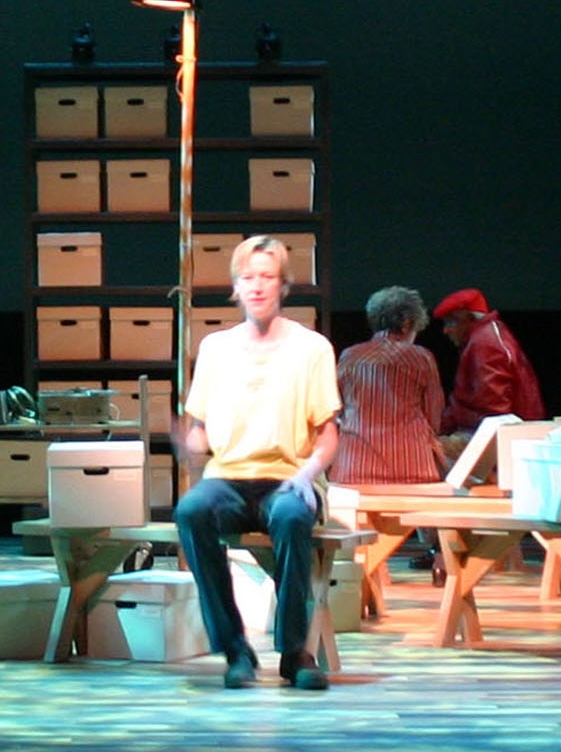
The morning my colleagues and I spent with Juanita was part of our research and interview process for the play, “The People’s Temple,” which premiered at Berkeley Repertory Theater in 2005. Margo Hall, Steve Wangh, and I met Juanita through Melody Ermachild Chavis, who had been one of the investigators on Larry Layton’s legal defense team and who herself had interviewed hundreds of survivors in Jonestown’ aftermath.
Melody had stayed in touch with Juanita over the years, and prepped us ahead of our time with her. She cautioned that Juanita might be mentally fragile, physically frail, or unable to recall details because she had “blocked them out” completely. Juanita had struggled with alcoholism and addiction over the years, Melody explained, so we should be prepared for that as well, that she might be under the influence.
What we found when we arrived at Juanita’s apartment was a welcoming presence. She was not under the influence. She was cogent. Friendly. She wanted to talk. She sat in an armchair looking out that window, answering our questions as they came at her one by one.
Some things stood out, details and sentiments that have stayed with me. First, Juanita was pregnant with her son Chad when she left Jonestown with her family that day, but she didn’t yet know it.
She recalled with clarity, Jones saying to the family in the pavilion, “anyone who leaves here, leaves in a pine box.” She talked at length about the surreality of her parents joining Peoples Temple in Redwood Valley, when she was just a teenager, and having no choice but to go along to get along. She spoke often about her brother, Tommy Bogue, and a different pine box – a deprivation box, the one used for punishment – which we had heard about, but had found hard to believe. Juanita confirmed its existence.
The most striking thing by far was her statement about responsibility. She calmly explained how people in the Jonestown community would turn on one another and mete out punishment. How she and her brother had both been on the receiving end of physical punishment by other members. And then, she included herself in it. “I would do just the same to them,” she acknowledged. “We all participated. Every last one of us.” Juanita’s inclusion of herself in that statement was for us, at that time, a revelation. As thoughtful and self-reflective as so many of the survivors had been when we spoke to them, no one had stated the truth in such clear and direct terms: “We all participated.” That phrase continues to resonate for me today.
She also spoke of her experiences as a survivor, especially in the years immediately following Jonestown. She had found a job in an office doing secretarial work, but when she went to work one day, she found the office completely empty, with a note telling her to take her things and not to come back. That image of the empty office summed up the impossibility of rebuilding a healthy, stable life after Jonestown. The hill she – and so many others – had to climb.
Juanita explained to us that she told her kids about their family history during an episode of the “Oprah” show, which had featured survivors of Jonestown. She pointed to the TV and said to her kids, “That’s us. That’s our family.” She recounted how people – other survivors – had blamed her after Jonestown, saying things like, “Why didn’t you take my kids with you when you left…” It was a thought she lingered on for a long time.

When I heard the news of Juanita’s passing, I felt sad for what she had suffered, the trauma she had lived through, and the lasting imprint it had made on her life and her children’s lives. I thought about her son, Chad, who was convicted of killing a police officer in Oakland. Melody Ermachild Chavis had stayed in touch with Juanita because she was part of Chad’s legal team as well – fighting in the sentencing phase for Chad to have life in prison instead of the death penalty. Telling his life story in court, in order to save his life, a story which included being in utero on November 18, 1978.
From time to time, I do feel sad and sorry for Juanita. I’m not sure pity is the right response to tragedy, but I fall into it sometimes. In writing this remembrance, I want to honor the wisdom in her simple phrase: “We all participated.” Whether it’s our current administration, our family system, or a fall out with a friend, when things go awry, there is participation, culpability, responsibility on all sides. Juanita’s legacy is her recognition of our interdependence. We are all connected.
After our visit with Juanita, Melody spoke to us about generational trauma – she was well ahead of her time on that – and how Chad carried that burden of Jonestown into his own life, the circumstances of where he lived, who he interacted with, everything that led to the violence that unfolded in Oakland, the day he killed a cop by firing an assault rifle into the air. The starting point for healing seems to me to be an acknowledgement of that generational trauma, and that recognition of participation.
We did promise Juanita’s youngest son, who was there that day of the interview, that we would return to take him to Chuck E. Cheese. We never did make it back for that. I think about that broken promise from time to time. I’m sorry we never made it back.
Juanita’s words were included in our play, “The People’s Temple,” and the moral clarity of the statement – “We all participated. Every last one of us” – was an important part of how the drama unfolded on stage. Adding to the complexity of this story. I’ve spent my whole career conducting interviews, and there are some that stay with you. This one has stayed with me ever since that day more than 20 years ago.
May Juanita rest in peace, and may her family legacy be one of healing, across the generations. May her moral clarity uplift her and hers, and may she be made whole in mind and in body, on into the future beyond.