
When I think of Eusi Kwayana, I inevitably picture him with my father, John Moore. The two men were both tall, imposing, and reserved. They were kind, thoughtful, and wise. They were also ancient, in my eyes. John died a few weeks shy of his 100th birthday in 2019, while Eusi died this October at age 101.
I believe I first encountered Eusi and his wife Tchaiko at a public event at San Diego State University, probably in 2007. Tchaiko asked a question from the audience, and after the event we introduced ourselves. That led to ongoing encounters primarily at Temple survivor reunions in San Diego as well as dinners at our family home. Not surprisingly, we connected over Jonestown and Guyana, where Eusi was born and lived through the nation’s tumultuous colonial and postcolonial periods.
Richard Drayton has ably described Eusi’s political biography as a leader in Guyana’s independence movements. I would like to focus here on Eusi’s contributions to Jonestown scholarship as well as on our personal contacts.
* * * * *
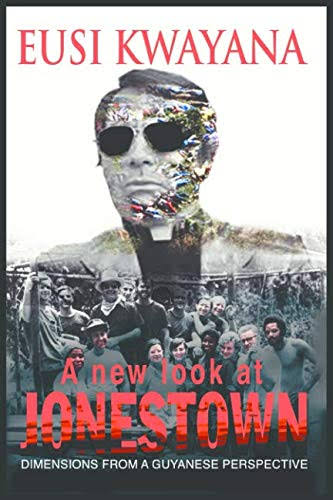 Most important in terms of history is his edited volume A New Look at Jonestown (2016, with reviews by Khaleel Mohammed and Laura Johnston Kohl). The book presents a wealth of interviews, articles, and primary sources from Guyana, in contrast to Shiva Naipaul’s book Journey to Nowhere (1980), in which the Anglo-Trinidadian presents a more general perspective.
Kwayana’s book includes interviews he conducted with Temple survivors about their life in Jonestown as well as discussions with Guyanese individuals knowledgeable about the project (chapters 1, 2, 3). A fascinating analysis by Guyana’s Agri-Audit Task Force offers results from its post-Jonestown study of the agricultural prospects for the land (chapter 4). “We believe that this commune would be developed into a thriving agricultural settlement” if certain procedures were followed, the task force concluded.
A New Look at Jonestown also includes leading Caribbean intellectual Walter Rodney’s analysis of why Guyana was the site of the tragedy (chapter 9; see also “Jonestown: A Caribbean/Guyanese Perspective”). Rodney was assassinated by Guyana government forces in 1980; Eusi Kwayana testified at the Walter Rodney Commission of Inquiry in 2014.
I find Eusi’s articles published in the week following the Jonestown deaths to be the most important items in the volume. His commentary from November 21, 1978, titled “A State Within A State” (chapter 11), reprints the list of questions he raised after the tragedy, including why a town in Guyana would be named after an American, namely Jim Jones. In several paragraphs reminiscent of Émile Zola’s J’accuse, Eusi charged the Guyana government with criminal acts:
The regime stands accused of criminal negligence . . . The regime stands accused of criminal greed . . . The regime stands accused of criminal conspiracy . . . The regime stands accused of criminal arrogance . . .
In short, A New Look at Jonestown is a vital resource for understanding the impact the tragedy had upon the nation of Guyana.
* * * * *

We met Eusi after he had retired to San Diego with his wife Tchaiko, a high school and college teacher. As Drayton notes, Eusi did indeed have a special, raw food diet, so mainly ate salad when he came to dinner. He did enjoy Fielding’s homemade ginger punch, which is basically a lot of ginger, a little sugar, and some vanilla. We would talk about current politics in the United States and in Guyana.

He and Tchaiko also attended several reunions of Temple survivors held in San Diego. They became special friends of Laura Johnston Kohl. They both attended the last San Diego survivor reunion, held in 2014. I remember Eusi sitting next to John in a backyard patio, two wise old men observing the younger generations. There was an unusual connection between the two. Eusi grew up in the village of Buxton in Guyana; John’s family on his mother’s side were the Buxtons. The name undoubtedly originated in the town of Buxton in the Midlands of England.
Can any conclusions be drawn from the friendship between colonized and colonizer? Their shared commitment to working for social justice – national liberation in Guyana for Eusi, anti-war activism and gay liberation for John – bound them together despite obvious racial and ethnic differences. Both saw the Jonestown experiment as one of promise and of failure. Eusi bore its marks politically as a radical leader in Guyana; John bore them personally in the deaths of his daughters and grandson.
And yet, here they were, elders who had lived through many disasters and changes – sitting, talking, and smiling in the summer sun.
(Rebecca Moore is Professor Emerita of Religion at San Diego State University, and has written and published extensively on Peoples Temple and Jonestown. Rebecca is also the co-manager of this website. Her full collection of articles on this site may be found here. She may be reached at remoore@sdsu.edu.)