In September of 2025, I visited the National Archives (NARA) building in Washington, DC (Archive I). Unlike most visitors, my focus was not on visiting the Rotunda – home of the Declaration of Independence, the Constitution, and the Bill of Rights – rather, I found myself glued to a wooden chair in an airy research room facing Pennsylvania Avenue.
Working nonstop from 9 a.m. to 5 p.m. over a week, I worked to research and scan 27 boxes of Peoples Temple materials generated as the House International Relations Committee’s Records on Jonestown and the Assassination of Representative Leo J. Ryan.
Archives I is home to the Center for Legislative Archives, the permanent repository for most historical records from the U.S. House of Representatives and the Senate. Part of this expansive (and largely untouched) archive are the records used in the preparation of the House Committee on Foreign Affairs Staff Investigative Group’s (SIG) report on the assassination of Congressman Ryan.[1]
Prior to my visit, I read the article in the 2018 edition of the jonestown report by journalist Mark Stricherz, who detailed his experience researching the SIG’s records on Jonestown at Archives I. While I was intrigued by his experience – and especially by the 11 boxes of interview transcripts with survivors, State Department personnel, and former Peoples Temple members – the idea of researching the collection faded from my memory, mostly in consideration of my already-lengthy “Jonestown to-do” list. However, when I found myself living in Washington, DC, for the final months of 2025, I figured I would scour America’s capital in search of any and all collections pertinent to Jonestown.
In anticipation of my visit, I spoke with Mr. Stricherz, who kindly answered all my questions regarding the collection. Following that conversation, I decided that I would attempt to scan the entire – or as much as I could – of the collection within a week. After all, I had managed to successfully scan over 6000 pages over the course of three days during a trip to Friday Harbor.
 Although my plan to see the collection was made at the last minute, I had no problem walking into the archive without an appointment, obtaining my researcher’s card, and putting in my request to access the collection. Within about 30 minutes, an archivist had delivered a large cart containing the collection’s boxes to my desk.
*****
On December 28, 1978 – a month following the events of November 18, 1978 – Clement J. Zablocki, Chairman of the House Committee on International Relations, authorized the creation of a “comprehensible inquiry” into the assassination of Congressman Leo J. Ryan and the mass suicide/murder of Peoples Temple members in Guyana. The inquiry was led by a Staff Investigative Group (SIG), consisting of Staff Consultant George R. Berdes, Subcommittee Staff Director Ivo J. Spalatin, and Minority Staff Consultant Thomas R. Smeeton. The purpose of the inquiry was to focus on questions such as the following:
What did the Department of State know about the activities of the People’s Temple in Guyana?
Did the U.S. Government or the Government of Guyana have any evidence to suggest that there was a potential for violence at Jonestown?
What was the relationship between the Government of Guyana, its officials and the People’s Temple?
Through this inquiry, the SIG was authorized to obtain pertinent documents from all relevant federal agencies and interview individuals formerly a part of, or connected to, Peoples Temple and the events of November 18, 1978. Over the span of the next five months, the SIG collected and reviewed thousands of documents relating to Peoples Temple and its relationship to the U.S. State Department and other federal agencies. The three staffers also visited Jonestown and formally interviewed 62 individuals. The findings of their research were officially published in May 1979: The Assassination of Representative Leo J. Ryan and the Jonestown, Guyana Tragedy: Report of a Staff Investigative Group to the Committee on Foreign Affairs, U.S. House of Representatives.
The version of the 777-page report available to the public mostly consisted of newspaper clippings, with few pages of research or analysis. However, the confidential version of the report – available to members of Congress and others with appropriate clearances – featured appendixes with summaries of the interview transcripts, among other findings. But now that it has been more than 40 years – 10 years past the 30-year seal on House records – the confidential version of the report, along with all 27 boxes of materials gathered by the SIG, is officially available to the public.
Fielding McGehee, the manager of this site, once told me that the SIG archive had been on the top of his list for his most-wanted Peoples Temple materials, but that the distance between Washington DC and the Jonestown Institute’s offices in Friday Harbor precluded a visit. Kate Mollan, an archivist at the Center for Legislative Archives, also explained to me that besides Mr. Stricherz and Congresswoman Jackie Speier, I had been the only other researcher to ever request access to the collection.
*****
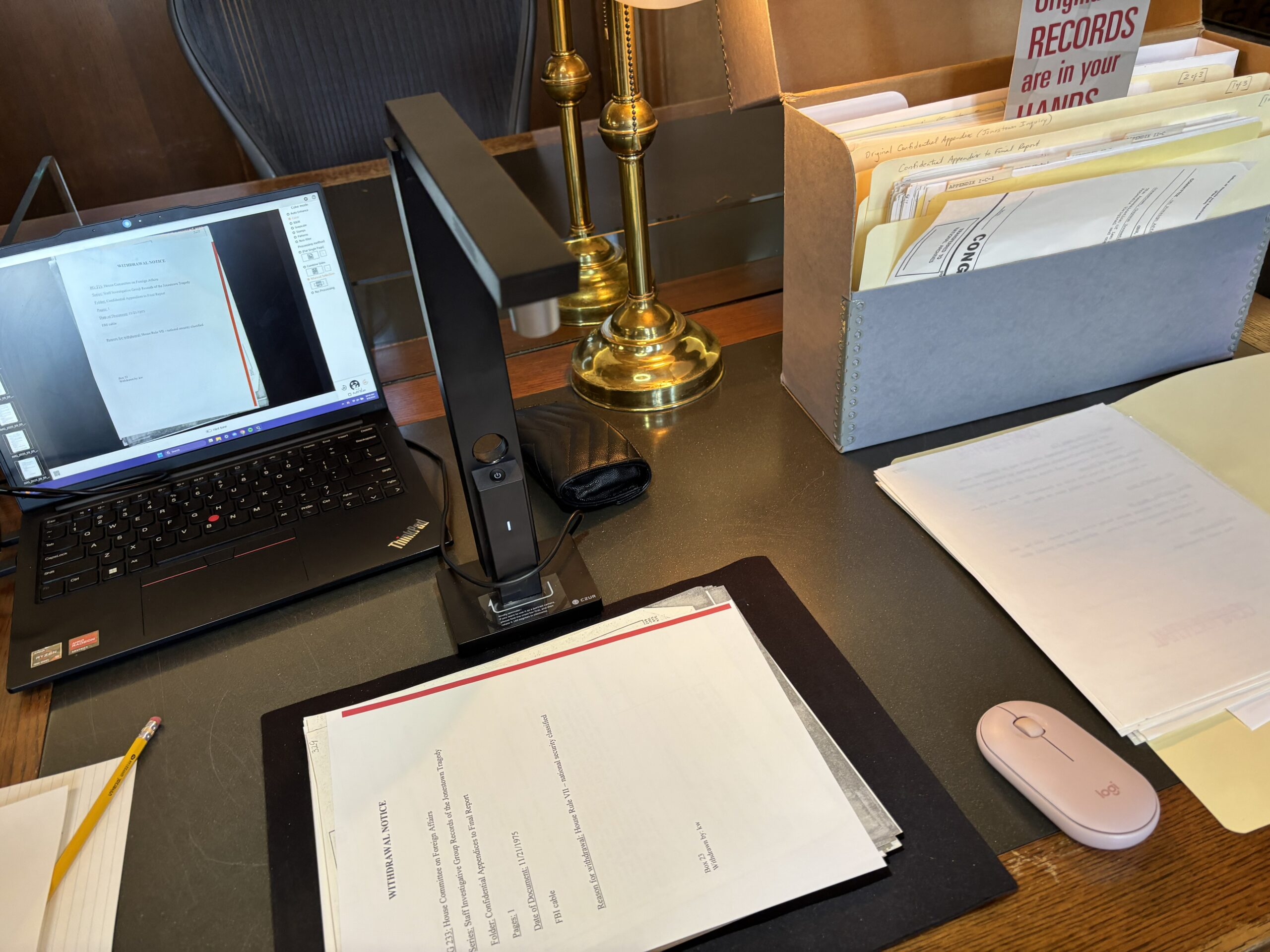 I only had five days from 9 to 5 p.m. to scan (which seems like a lot of time, although I discovered in Friday Harbor that time flies by when scanning), so I had to be strategic when selecting what boxes to scan first. Ultimately, my greatest priority was the 11 boxes of interview transcripts.
A full list of the interviewees is available in the collection’s finding aid, but the list includes many familiar – and of course, many rarer – names. From Jonestown survivors like Odell Rhodes and Stanley Clayton, to members of Congressman Ryan’s congressional and press delegation like Steve Sung and Jackie Speier, to prominent Peoples Temple defectors like Teri Buford and Grace Stoen, to U.S. Embassy officials or other government personnel like Richard Dwyer, Joe Holsinger, and John Burke, the SIG evidently managed to interview a significant and diverse number of individuals.
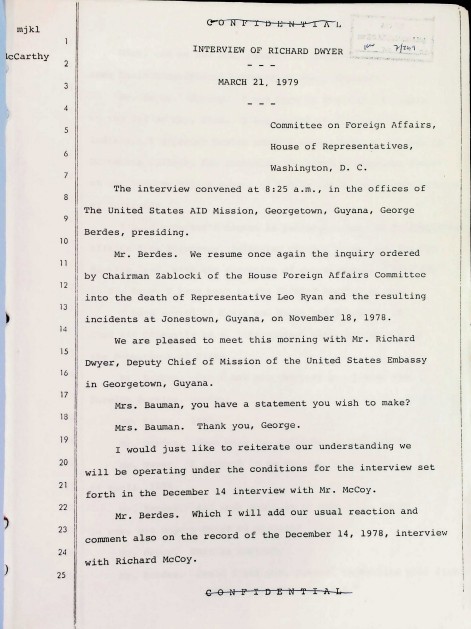
Many of the interviewees have been interviewed on the official record before (e.g., through the FBI’s debriefing of Jonestown survivors for its RYMUR investigation and in the federal Grand Jury investigation of Larry Layton concerning the assassination of Congressman Ryan). Nevertheless, I found the SIG interviewe to be more thorough and of greater substance. Although I have yet to fully read and annotate all the transcripts, it appeared to me that the interviewers – or in this instance, the interviewees – no longer had the concern of influencing a jury’s verdict or their own criminal fate on their minds, allowing for more relaxed, substantial, and open-ended conversations.
Interestingly enough, while skimming along the SIG’s notes from their interview process during their trip to Guyana and Jonestown, the three consultants attempted to interview a number of Guyanese who had direct information. Officials at the American embassy in Georgetown expressed skepticism at the idea, however, and they dropped the request.
*****
Another priority on my list was box 18, which contained a folder on the CIA’s intelligence on Peoples Temple. Out of all of the federal agencies with records on Peoples Temple, the CIA has been stiff when it has come to FOIA requests and mandatory declassification reviews, citing national security exemptions.
Unsurprisingly, the folder contained a single withdrawal notice for 58 pages from the CIA, citing House Rule VII for a national security exemption. Unfortunately, records originating from the legislative branch are not subject to the provisions of FOIA, so it is next to impossible to attempt to FOIA exempted documents from the collection. However, the withdrawal notice – and the specific mention of 58 pages – provides definitive proof of the existence of CIA records on Peoples Temple, which should help in future FOIA requests to the CIA and challenging potential “GLOMAR” responses.
On a related note, it is unlikely – in my opinion – that there are damning revelations of a conspiracy against Congressman Ryan or Peoples Temple within those 58 pages (most documents from three-letter agencies tend to consist of rather mundane administrative memoranda and such). Nonetheless, the small number of available snippets of CIA intelligence on Peoples Temple have provided pretty stark revelations on the November 18 timeline of events.
*****
One of my unexpected discoveries was that of Peoples Temple case records and audiotape collection belonging to Joe W. Holsinger, Congressman Ryan’s staff assistant. Prior to the congressional delegation’s trip to Guyana, Congressman Ryan, Jackie Speier, and their assistants, Joe and Will Holsinger, spent much of their time interviewing members of the Concerned Relatives group, identifying Jonestown residents who may potentially want to leave, and preparing their Guyana itinerary. In a handful of documentaries and interviews, Jackie Speiers and others have occasionally referenced the existence of recorded interviews with Temple defectors and members of the Concerned Relatives group. I previously assumed that the tapes were lost to time, yet they have been sitting in the National Archives for the past 40 years.
The archivists at NARA were kind enough to digitize and furnish 11 out of the 34 tapes on a CD to me. The remaining tapes – which also include tapes of the FCC recordings of the Temple’s ham radio conversations across Jonestown, Georgetown, and San Francisco – are pending digitization and final review by the archivists. I, along with Shannon Howard, am in the process of cleaning up and transcribing the tapes to post to this site.
Additionally, I was quite surprised to find a number of documents created by the congressional delegation during their ill-fated trip to Jonestown. For example, I found Vernon Gosney’s handwritten November 17, 1978, agreement to transfer custody of his son, Mark Gosney, to Edith Cordell.
*****
Finally, one of my most exciting finds was that of the SIG’s notes on NBC’s footage from the Guyana trip. While NBC reported the existence of more than 13 hours of footage to the FBI after the tragedy, much of it has never been publicly released. The SIG notes, created from viewing the tapes at FBI Headquarters in May 1979, confirmed the existence of unreleased footage, including interviews with Concerned Relatives, Peoples Temple representatives, among others, as well as b-roll of the delegation’s travel to Guyana.
Some footage has appeared in documentaries, but significant portions – including the complete 25-minute Don Harris interview with Jones – remain missing. (A more detailed report on the SIG’s notes and NBC’s missing footage appears here.)
*****
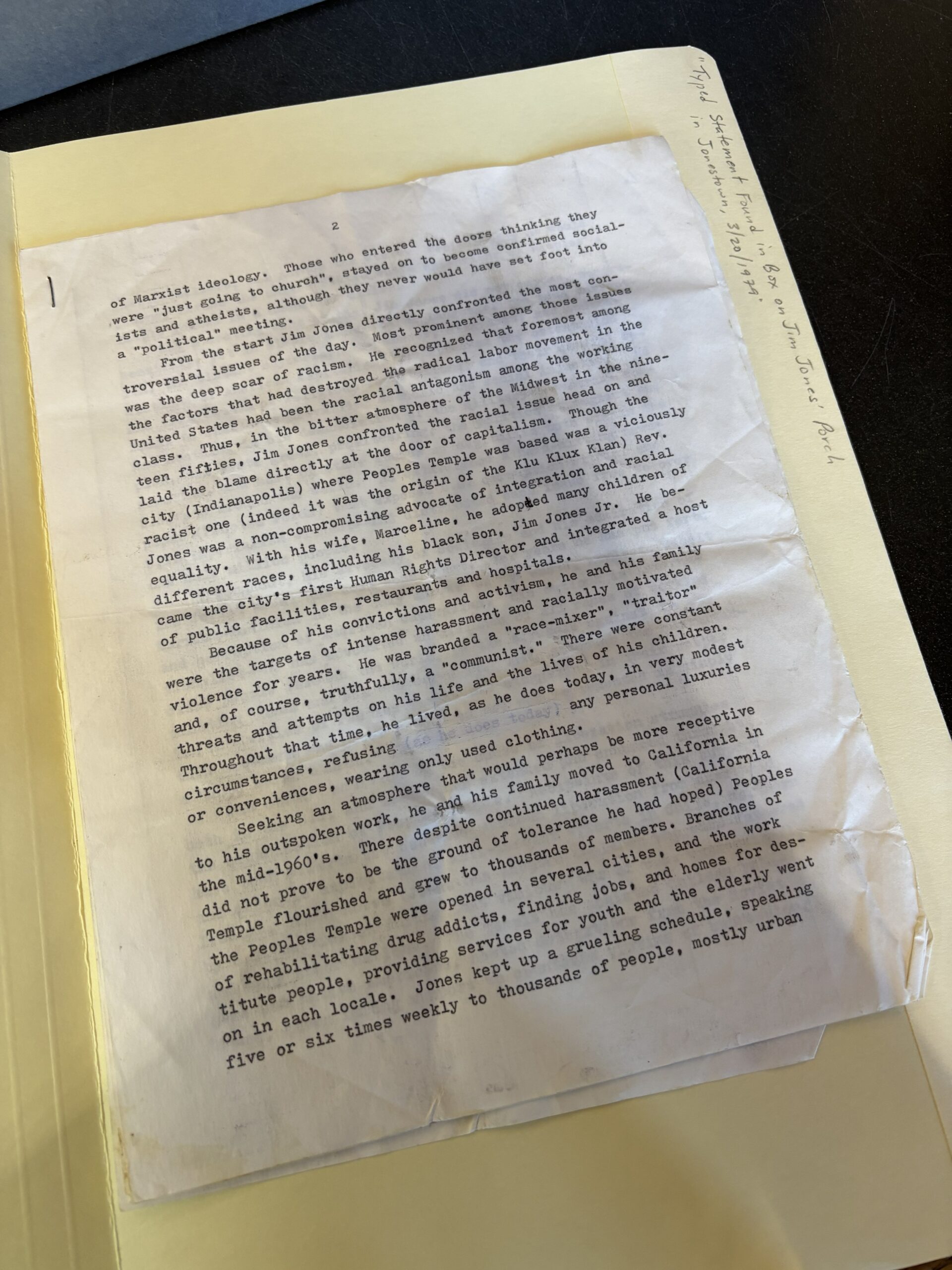
After a week of scanning and skimming files, I concluded that the public report of the House Committee on Foreign Affairs released in May 1979 paled in importance and substance in comparison to the extensive research and interviewing process of the SIG. Despite its size, it featured little of the information, analysis, and minutiae details available in its 27 boxes of research files.
But perhaps 40 years needed to pass before researchers would have been able to fully appreciate and utilize the fact-finding efforts of the SIG to investigate an assassination and tragedy few can comprehensively explain.
Over the next months and years, many of the documents from the collection will be posted and transcribed on this website and the new Military Response to Jonestown project. Otherwise, researchers may access the collection in person at Archives I in Washington, DC.
(Aliah Mohmand is a student with an interest in Peoples Temple. Her research has resulted in multiple projects regarding the aftermath of the Jonestown tragedy. Aliah attends Kalamazoo College, pursuing studies in History and Finance. Her full collection of articles for this site may be found here. She may be reached at aliahmohmand@gmail.com.)
Note
[1] From 1975 to 1978 and 1995 to 2007, the House Committee was named the Committee on International Relations; however, during the release of the SIG report in 1979 and at the time of this article’s publication, the House Committee was – and is now – named the House Committee on Foreign Affairs.